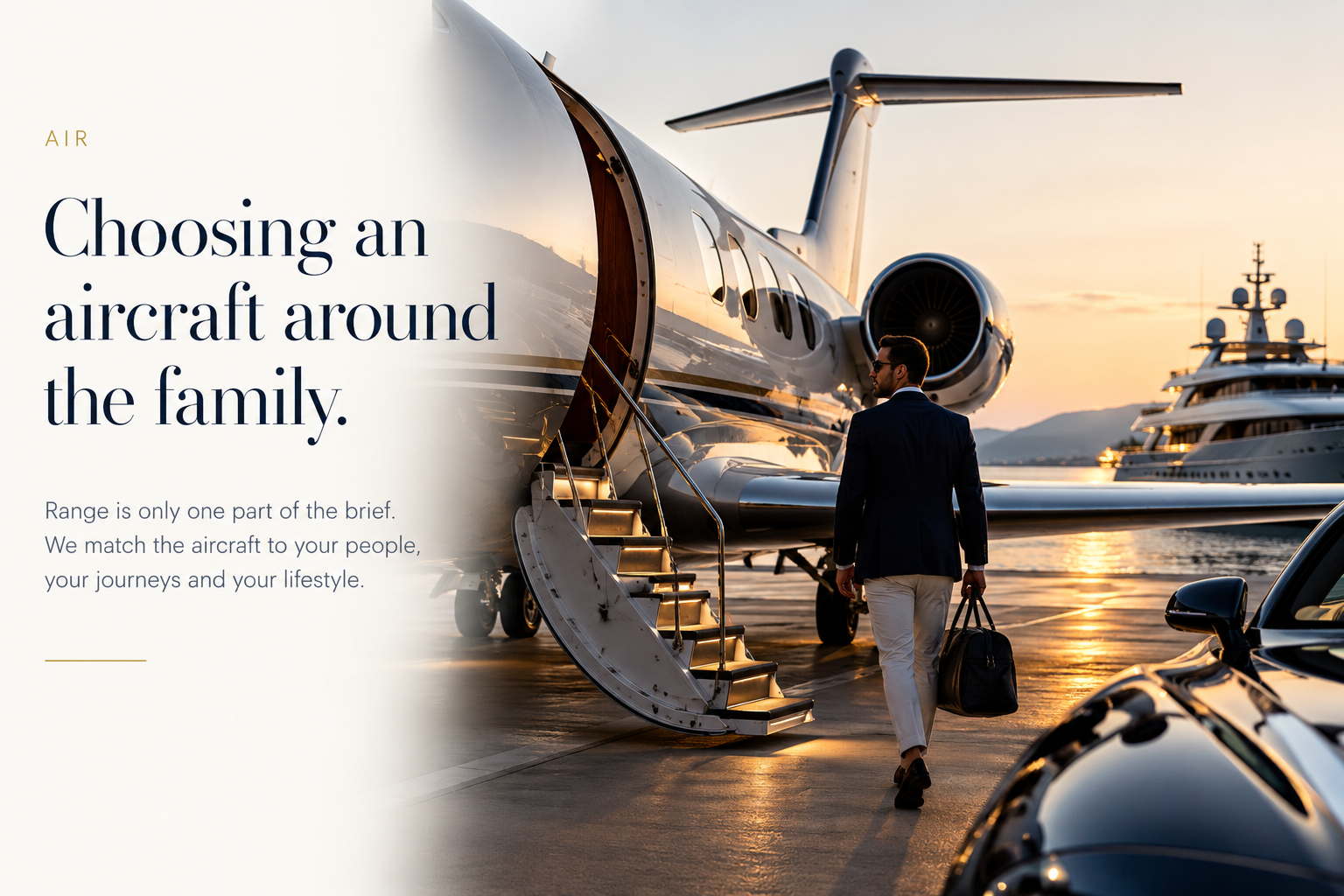
Choosing an aircraft for a family.
For family travel, aircraft choice is usually decided by the mission before it is decided by the badge on the tail: passengers, baggage, sleep, airport performance and what actually needs to happen in the cabin.
Start with the mission, not the category
“Light”, “midsize” and “heavy” are useful market labels, but they are not a substitute for the specification of the actual aircraft being offered. Two aircraft in the same broad class can have different baggage access, cabin dimensions, seating layouts and runway requirements.
Baggage is a physical question
Do not rely on a generic baggage number. We ask the operator for the usable compartment volume, loading-door dimensions, whether baggage is externally or internally accessible, and any weight limits that matter on the planned sector. Pushchairs, skis, golf bags, hard cases, musical instruments and pet carriers can change the aircraft choice before passenger count does.
Cabin height matters more as the flight gets longer
Standing room, aisle width and cabin zones affect how a six- or ten-hour flight feels. Rather than assume a class average, compare the finished cabin dimensions of the actual types proposed. For context, a current Gulfstream G600 lists a finished cabin height of 1.88 m, but other aircraft differ materially.
Ask what “sleeps” actually means
An overnight mission needs a layout conversation, not a seat-count conversation. Confirm which seats or divans convert, how many usable berths the proposed configuration creates, whether a zone can be closed off, and what remains accessible when beds are made. The same aircraft type can be fitted differently by different owners or operators.
Lavatory, galley and cabin service
On shorter-range aircraft, lavatory privacy, galley capability and storage vary widely. If a fully enclosed lavatory, hot meal service, child-friendly catering or a particular cabin setup matters, it belongs in the brief before sourcing begins.
Range is calculated for the trip in front of us
Published range is a certification or marketing reference, not a promise for a specific charter. The operating carrier must account for payload, runway length, airport elevation, temperature, winds, routing, alternates and fuel reserves. A route that looks nonstop on a brochure may require a fuel stop on the day, while another aircraft may complete it nonstop.
Children, pets and restraints
Operators have their own policies for child-restraint systems, unaccompanied minors, pets and cabin placement. Entry requirements for animals also vary by country and can change. For Great Britain, for example, dogs may require tapeworm treatment within a specified window in addition to the applicable identification, rabies and documentation rules. We verify the current requirements for the actual itinerary rather than relying on a generic checklist.
A useful family brief
That is enough to remove most unsuitable options and focus the search on aircraft that genuinely fit the trip.